Learn standard C programming using Arduino boards and discover how to control microcontroller hardware directly.
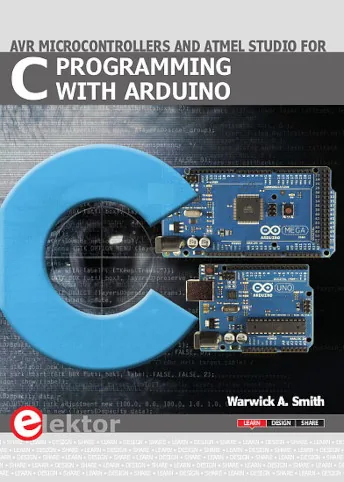
C Programming with Arduino teaches you the C programming language in an embedded systems environment using AVR based Arduino boards, including the Arduino Uno and MEGA 2560.
Using Atmel Studio / Microchip Studio and the AVR GCC toolchain, you will learn to write, compile, and load C programs while developing a deeper understanding of microcontrollers and embedded programming.
Go beyond the Arduino IDE. Learn the C programming language, understand how microcontrollers work, and develop the skills to program embedded systems.
What Is C Programming with Arduino?
Are you ready to take your Arduino programming skills to the next level?
The Arduino platform makes it easy to get started with electronics and microcontrollers, but there is much more to embedded programming than writing sketches in the Arduino IDE.
C Programming with Arduino is a practical way to learn the standard C programming language using an Arduino board as your development platform.
Unlike conventional Arduino programming, which uses the Arduino IDE, this approach uses standard C and Atmel Studio / Microchip Studio to program AVR microcontrollers directly.
Learning Arduino and C gives you greater insight into how microcontrollers work and provides programming skills that can be applied to many other embedded systems.
This book takes you step by step through the C language, starting with simple programs before progressing to hardware control, debugging, and practical projects.
What You Will Learn
The book contains 17 chapters covering C programming fundamentals and their application to embedded systems.
Topics include:
- C programming basics: Variables, data types, operators, decisions, loops, and functions.
- Number systems: Binary, decimal, hexadecimal, and ASCII.
- Memory and microcontrollers: RAM, ROM, memory architecture, and pointers.
- Hardware control: Accessing AVR ports, controlling LEDs, and reading switches.
- Bit manipulation: Bitwise operators, logical operators, and microcontroller registers.
- Hardware peripherals: Timers, counters, analogue-to-digital conversion, and interrupts.
- Debugging: Using Atmel Studio to examine variables, memory, and hardware registers.
- Advanced C: Arrays, strings, structures, unions, and pointers.
Exercises and solutions are included to help reinforce the programming concepts covered in each chapter.
Practical C Programming Projects
You will apply what you learn by developing programs that interact with actual microcontroller hardware.
Projects and practical examples include:
- Controlling onboard and external LEDs.
- Reading switches using microcontroller input ports.
- Developing serial port driver functions.
- Converting numbers into strings.
- Building a digital voltmeter.
- Programming a stopwatch.
These examples demonstrate how the C language can be used to develop practical embedded applications.
Why Learn the C Language for Arduino?
The C programming language is widely used in embedded systems because it provides efficient access to hardware and produces compact programs suitable for microcontrollers with limited memory.
Learning C offers several advantages:
- Gain greater control over Arduino hardware.
- Understand how microcontrollers interact with electronic components.
- Develop skills that are transferable to other microcontroller platforms.
- Learn programming techniques used in professional embedded development.
- Move beyond basic Arduino sketches and explore lower-level hardware programming.
Arduino provides an accessible platform for learning these concepts, while standard C gives you a foundation for working with many other embedded systems.
Hardware and Software Requirements
This book uses AVR based Arduino boards and Atmel Studio. You will need:
| Requirement | Description |
|---|---|
| Arduino board | Arduino Uno R3 or MEGA 2560 R3 |
| Programmer | AVRISP mkII, AVR Dragon, Atmel ICE or other AVR USB programmer compatible with Microchip Studio |
| Software | Atmel Studio for Windows |
| Components | LEDs, resistors, switches, and other basic electronic components |
| Accessories | USB cable and connecting wires |
Important: This book uses Atmel Studio and standard C, not the Arduino IDE. A compatible AVR programmer is required to load programs using the development method described in the book.
Frequently Asked Questions
Do I need previous C programming experience?
No. The book starts with basic C programming concepts and gradually introduces more advanced topics. Previous programming experience is helpful but not required.
Can I use the Arduino IDE with this book?
No. The book uses Atmel Studio and the AVR GCC toolchain to teach standard C programming. It does not follow the conventional Arduino IDE approach.
Which Arduino boards are supported?
The example programs are written for AVR based Arduino boards and have been tested on the Arduino Uno and Arduino MEGA 2560.
Do I need a programmer to follow the examples?
Yes. An AVRISP mkII, AVR Dragon, Atmel ICE or other AVR USB programmer is required to load programs onto the Arduino boards using Atmel Studio / Microchip Studio. The AVR Dragon and Atmel ICE both support debugging.
Does the book teach standard C or Arduino programming?
The book teaches standard C programming in an embedded systems environment. Arduino boards are used as the hardware platform for learning C and programming AVR microcontrollers.
Buy C Programming with Arduino
Take your Arduino programming skills further by learning standard C and understanding how microcontrollers interact with hardware.
Whether you are an electronics hobbyist, student, or aspiring embedded systems developer, this book provides a practical introduction to C programming and embedded applications.
Learn C. Program microcontrollers. Build your embedded programming skills.
Buy C Programming with Arduino from Elektor
You may also be interested in Explore ATtiny Microcontrollers using C and Assembly Language which teaches AVR assembly programming using inexpensive ATtiny devices, helping you understand processor architecture, registers, memory, instruction timing, and debugging through practical projects and step-by-step explanations.