
If you want to master AVR assembly language, understanding how AVR microcontrollers work internally is one of the best ways to become a better embedded systems programmer.
Explore ATtiny Microcontrollers using C and Assembly Language teaches AVR assembly programming using inexpensive ATtiny devices, helping you understand processor architecture, registers, memory, instruction timing, and debugging through practical projects and step-by-step explanations.
In addition to teaching assembly language for AVR microcontrollers, the book give many program examples in the C language as well. This allows the reader to examine the assembly language that C programs generate, and compare C and assembly language.
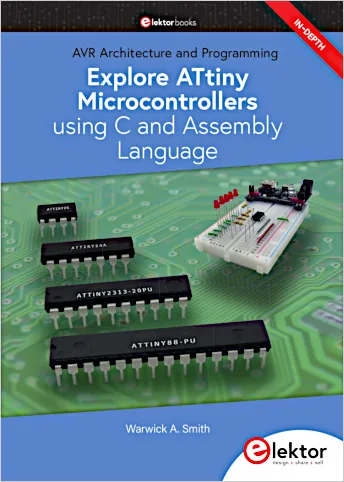
If you bought this book then visit the Explore ATtiny Microcontrollers using C and Assembly Language Resources page that contains downloads, web links, Arduino sketches and errata.
What Is AVR Assembly Language?
AVR assembly language is the low-level programming language used to write programs that execute directly on AVR microcontrollers. Unlike high-level languages, assembly language gives you direct control over CPU registers, memory, and hardware peripherals.
Learning AVR assembly language helps you:
- Understand how AVR microcontrollers execute instructions
- Write highly efficient embedded software
- Improve debugging and optimization skills
- Better understand compiler output
- Gain a deeper knowledge of microcontroller architecture
Explore ATtiny Microcontrollers using C and Assembly Language teaches these concepts through practical examples using popular ATtiny devices and Microchip Studio.
Learn AVR Assembly Language Through Practical Projects
Rather than focusing only on theory, this book teaches AVR assembly language by building real programs that run on inexpensive ATtiny microcontrollers.
You will learn how to:
- Read and understand CPU registers
- Write efficient assembly language routines
- Debug software using Microchip Studio
- Examine machine code generated by the assembler
- Compare C programs with their assembly output
- Understand instruction timing and execution
Every topic builds on previous chapters, making it suitable for beginners while still providing valuable insight for experienced embedded developers.
Explore the Internal Architecture of AVR Microcontrollers
Understanding the internal operation of AVR microcontrollers is essential for writing reliable embedded software. This book explains:
| CPU Architecture | How instructions are executed |
| Registers | Working directly with processor registers |
| Memory Map | Program memory, SRAM, EEPROM, and I/O |
| Instruction Set | How machine instructions operate |
| Timers and Clocks | Timing, delays, and processor operation |
| Debugging | Finding and fixing software problems |
Instead of treating the microcontroller as a “black box,” you’ll learn exactly what happens inside the processor while your program runs.
Why Learn AVR Assembly Language Alongside C?
One of the strengths of this book is that it teaches both C and AVR assembly language together.
By learning both languages, you will understand:
- How C programs are compiled
- How assembly instructions correspond to C statements
- Why certain code executes faster
- How memory is organized
- How compilers generate optimized machine code
This combination provides a much stronger understanding than learning either language alone.
Assembly Language Programming Made Easy
Many engineers consider assembly language programming difficult because they begin with abstract examples. This book instead introduces concepts gradually using simple ATtiny hardware and the built-in Microchip Studio simulator. Topics include:
- Writing your first assembly program
- Using assembler directives
- Working with registers
- Branching and loops
- Subroutines
- Stack operations
- Interrupt basics
- Instruction timing
Each chapter builds practical skills that can immediately be applied to real embedded projects.
Learn with Real Assembly Language Code Examples
The book contains numerous assembly language code examples that demonstrate how AVR instructions interact with hardware.
These examples help you understand:
- Digital input and output
- Register manipulation
- Bit operations
- Program flow
- Memory access
- Arithmetic instructions
- Timing routines
- Hardware control
Studying working code makes it much easier to understand how AVR processors execute instructions.
Supported AVR Microcontrollers
The book focuses on low-cost DIP-packaged ATtiny devices that are ideal for breadboard projects and learning. Supported devices include:
- ATtiny13
- ATtiny13A
- ATtiny25
- ATtiny45
- ATtiny85
Because these are standard AVR microcontrollers, the knowledge gained can easily be transferred to many other AVR devices, including ATmega microcontrollers.
Learn Assembly Programming with Affordable Hardware
Getting started with assembly programming does not require expensive development tools. The book supports several programming methods:
- Atmel-ICE programmer and debugger
- Low-cost USB ISP programmers
- Arduino Uno used as an ISP programmer
- Microchip Studio AVR simulator
Many of the examples can be completed entirely within the simulator before programming actual hardware.
Why Choose This Book?
Explore ATtiny Microcontrollers using C and Assembly Language offers a practical approach that combines theory with real-world programming experience. Highlights include:
- Full-color illustrations
- Step-by-step lessons
- Coverage of AVR architecture
- Detailed debugging techniques
- Simulator-based learning
- Practical C and assembly examples
- Breadboard-friendly hardware
- Suitable for beginners and experienced developers
The emphasis on AVR assembly language gives readers a solid understanding of how embedded software interacts with hardware.
Who Should Read This Book?
This book is ideal for:
- Electronics hobbyists
- Embedded systems beginners
- Engineering students
- Arduino users wanting to learn lower-level programming
- Engineers moving from C into assembly language
- Anyone interested in understanding AVR processors in greater depth
No prior experience with assembly language is required, although basic programming knowledge is helpful.
Frequently Asked Questions
What is AVR assembly language used for?
AVR assembly language is used to write highly efficient software that directly controls AVR microcontrollers. It provides complete control over processor registers, memory, and hardware peripherals. Understanding assembly language also gives a much better understanding of how the microcontroller actually works.
Is this book suitable for beginners?
Yes. The material progresses from basic concepts to more advanced topics, making it suitable for readers who are new to AVR microcontrollers or assembly language programming.
Does the book teach both C and assembly language?
Yes. One of the book’s strengths is explaining how C programs relate to assembly language, helping readers understand how software is translated into machine code.
Do I need expensive hardware?
No. You can use inexpensive ATtiny devices, a hobby USB programmer, an Arduino Uno configured as a programmer, or even complete many exercises using the Microchip Studio simulator.
Which AVR microcontrollers are covered?
The primary focus is on the ATtiny13, ATtiny13A, ATtiny25, ATtiny45, and ATtiny85. The concepts also apply to many other AVR microcontrollers, including ATmega devices.
Does the book include assembly language code examples?
Yes. The book contains numerous assembly language code examples that demonstrate programming techniques, processor operation, debugging, and hardware control.
Where to Buy
Explore ATtiny Microcontrollers using C and Assembly Language is available from Elektor. It provides a comprehensive introduction to AVR architecture, C programming, debugging, and AVR assembly language, making it an excellent resource for anyone who wants to understand embedded systems at a deeper level. Whether you are building your first breadboard circuit or improving your embedded programming skills, this book offers practical knowledge that can be applied to a wide range of AVR microcontroller projects.