
The Arduino UNO R3 and earlier boards are covered by the Ultimate Arduino Uno Hardware Manual. It is a full color manual providing up-to-date hardware information for the Arduino Uno R3 or Rev3 (revision 3) open-source electronics platform.
Get all the information that you need on the hardware and firmware found on Arduino Uno R3 and earlier boards in this handy full color reference and user guide. Ideal for the workbench or desktop.
Arduino is the easy to use open-source electronics platform used by hobbyists, makers, hackers, experimenters, educators and professionals.
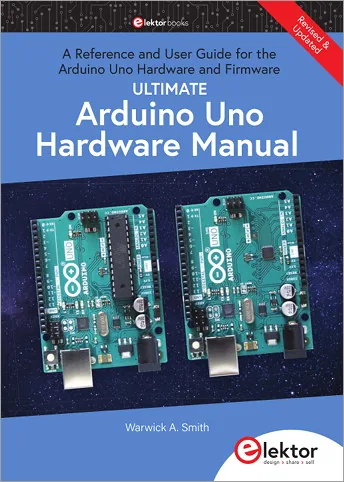
If you bought this book then visit the Ultimate Arduino Uno Hardware Manual Resources page that contains downloads, web links, Arduino sketches and errata.
About the Ultimate Arduino Uno Hardware Manual for the Arduino Uno R3
Everyone from beginners to advanced users can benefit from this easy to use guide. It is available as a downloadable PDF file to purchase from Elektor electronics.
Some of the features of the Ultimate Arduino Uno Hardware Manual include:
- Contains all of the Arduino Uno hardware information in one place
- Covers Arduino / Genuino Uno revision 3 (R3 or REV3) and earlier boards including updates to R3 boards
- Easily find hardware technical specifications with explanations
- Use the pin reference chapter with interfacing examples when building Arduino Uno projects or designing a shield
- Diagrams and illustration provide easy reference to alternate pin functions and hardware connections
- Learn to back up and restore firmware on the ATmega328P and ATmega16U2 microcontrollers on the Arduino Uno board, or load new firmware
- Basic fault finding and repair procedures show how to test a new Arduino Uno or repair a faulty one
- Power supply circuits are simplified and explained
- Mechanical dimensions are split into five easy to reference diagrams
- Find the circuit diagram or schematic in this book, as well as a parts list and a board layout reference to easily locate components on an Arduino Uno board
Shop for the Ultimate Arduino Uno Hardware Manual
Find the Ultimate Arduino Uno Hardware Manual PDF E-book at Elektor where it can be purchased as a PDF e-book. This book is available as a PDF file only and is no longer available as a physical printed book.
Visit the above link to see a preview of the book on the Elektor website. You can preview and buy the Ultimate Arduino Uno Hardware Manual on that page.
If you would like a printed book, then you may be interested in the Arduino UNO Hardware Manual that is available from Amazon stores as a black and white printed book.
About the Arduino Uno R3 Board
Arduino is the easy to use open-source electronics platform used by hobbyists, makers, hackers, experimenters, educators and professionals. Find the Arduino website at www.arduino.cc where more information can be found on the Arduino Uno R3 and other Arduino boards.
Although there is now an Arduino Uno R4 or revision 4 board, the Arduino Uno R3 board is still available. In addition, there are many clone and compatible Uno R3 boards from many different sources and manufacturers. One advantage that the R3 board has over the new R4 board is that the main microcontroller chip can easily be replaced. This is because it is mounted in a chip socket on the board.
Why Buy this Manual on the Arduino Uno R3 Hardware?
There are four main reasons to buy this book besides just wanting a handy reference manual for the Arduino Uno R3 and earlier hardware and firmware for use on the workbench. These reasons are discussed below.
- All the Hardware Information in One Place
Although there is a lot of information about the Arduino Uno R3 hardware available online, it is spread out over many pages and websites. Having all of the Arduino Uno hardware information in one place, in this concise guide, is convenient and a time saver. This is especially true for new Arduino users who may not even know what to look for when getting familiar with the Arduino Uno hardware, for example, how to extend the hardware, how to add external data memory, how to connect hardware to Arduino pins in current sinking and current sourcing configuration.
It also includes practical information such as how to replace the main microcontroller, which firmware needs to be loaded to a new microcontroller and which other settings must be changed for it to work. In addition, this manual has detailed hardware technical information, a pin reference chapter, basic interfacing information, a power reference chapter, information on all firmware programs loaded on an Arduino Uno, the circuit diagram and component list, fault finding and testing steps, as well as hardware mechanical dimensions and measurements. - Integrity of Information
Information on the internet about Arduino or any other subject may or may not be technically correct. Discerning which information is correct and which is incorrect is a problem, especially for those users who are new to electronics. Even hardware specifications from Arduino themselves are often badly specified or even incorrectly specified. This manual provides hardware information on the Arduino Uno that has been carefully checked and verified to be correct. - Presentation of Information
Each topic or subject in this book has been broken down into smaller parts and carefully explained and described. For this reason, each chapter contains many sections, each with its own sub-heading and section number for easy reference and cross-reference. Numerous illustrations and figures are included for easier understanding of explanations and for quick and easy reference. - Information Not Available Elsewhere
This book contains some information that is not available online, or is hard to find. It also offers unique views and illustrations of the hardware that reveal some interesting aspects of the Arduino Uno hardware that is not obvious when looking at the circuit diagram or other sources of information.
Target Audience
This manual has been written for anyone interested in the Arduino Uno R3 and earlier who would like an easy to use hardware reference, including hobbyists, makers, experimenters, teachers, students, and professionals such as electronic engineers.
Prerequisites
It is assumed that the reader of this manual has at least used the Arduino Uno on a basic level and has some basic knowledge of electronics. This is not a book that explains the basics of electronics, but assumes that the reader already has the knowledge to understand terms such as voltage and current, and knows what electronic components such as resistors and transistors are. In any case, this is the basic knowledge that is required to use an Arduino. Those readers who do not have this basic knowledge must at least be willing to learn, by using additional resources, be it via the internet or by using other books on the subject.
Hardware Requirements
At a minimum, an Arduino Uno R3 or earlier will obviously be required, as well as a computer with which to program the Arduino board. This book mainly references the Arduino Uno revision 3 (REV3 or R3) board. It also mentions earlier versions of the Arduino Uno when necessary and makes some reference to clone or compatible boards.
For advanced use and programming firmware to the Arduino Uno, one of several USB programmers can be used – see the text for more details, but most users will not need to do this, unless updating firmware on a new microcontroller, and even then there are cheaper alternatives such as using one Arduino to update the firmware on a second Arduino.
In the pin reference and interfacing chapter, an electronic breadboard and jumper wires are used to show how to interface LEDs, transistors, a relay, an external TWI memory chip and an SD card adapter. These are just interfacing examples and users will only need the components for a particular project or interfacing example that they are interested in. Hardware testing requires at least a multimeter. Some tests require an oscilloscope, but it is not essential for every user and is only used in a small section of the book.
Arduino Uno R3 Software Requirements
Without software, an Arduino Uno R3 does absolutely nothing. For this reason, although this is a hardware manual, the free Arduino IDE programming environment must be installed. This enables Arduino programs or sketches to be loaded to the Arduino Uno to operate and test the hardware.
All software used in this book is either free and open-source, such as the Arduino IDE software, or free software that is not open-source. All software used can easily be downloaded from the internet at no cost. Other software, besides the Arduino IDE, is optional and will only need to be installed if required for certain tasks.
What is Covered and What’s Not Covered
This book is primarily about hardware on an Arduino Uno R3 board, including technical information, a pin reference, power supply information, firmware details, circuits and parts list, fault finding and measurement, as well as mechanical information, but has to include some software, in the form of user programs or sketches, in order to get the hardware to work. That being said, it does not cover software programming in great detail, but does provide references to the appropriate example sketches in the Arduino IDE and online documentation where necessary.
Most of the functionality of an Arduino Uno R3 comes from the main microcontroller on the board. This microcontroller is covered by the text in the context of Arduino and how it is set up and used by the Arduino IDE and its libraries. Advanced use of some of the internal hardware in the main microcontroller that is not available in the Arduino IDE and libraries is not covered, except to provide a pin reference for these advanced features that shows which Arduino pins are mapped to advanced hardware. Users who want to use the advanced hardware that is not available in the Arduino IDE or libraries must reference the datasheet for the main microcontroller.
How to Use this Book on the Arduino Uno R3
It is suggested that this book is first read through once to get a good idea of its contents and a better understanding of the Arduino Uno R3 hardware, it can then be used as a reference manual. Although this book has been written as a manual, it is not dry like some manuals or textbooks. Anyone interested in Arduino should find it an enjoyable read.
For electronic engineers or competent hobbyists who have used other microcontroller boards, but not an Arduino Uno, this book provides an easy introduction to the Arduino Uno hardware that will get new users started quickly with the board. The first two chapters of the book are basically a hardware user manual, while the remaining chapters are more like a reference manual, although there is some overlap between the two.
When using the book for reference, use the index to find specific topics and use appendix A to quickly find technical specifications. Appendix A has a cross reference for each technical specification that references the same specification in the main text, which provides detailed information. Each section in the book cross references related material in other sections and chapters. The table of contents is also useful for referencing information, as it is a list of every section in the book.
Arduino Uno R3 Book Frequently Asked Questions (FAQ)
What is the Ultimate Arduino Uno Hardware Manual?
The Ultimate Arduino Uno Hardware Manual is a detailed hardware reference and user guide for the Arduino Uno R3 and earlier versions of the Arduino Uno board. It brings together technical specifications, pin references, firmware information, circuit diagrams, troubleshooting procedures, power supply details, mechanical dimensions, and much more in a single convenient resource.
Is this book suitable for beginners?
Yes. The manual has been written to be useful for both beginners and experienced users. Beginners can use it to better understand the hardware on the Arduino Uno R3, while advanced users can use it as a technical reference when designing projects, troubleshooting hardware, or developing custom solutions.
Does the book cover the Arduino Uno R3 (Rev3)?
Yes. The book primarily focuses on the Arduino Uno Rev3, also known as the Arduino Uno R3. It includes information specific to the Rev3 hardware as well as references to earlier Arduino Uno revisions where relevant.
Is this a programming book?
No. The primary focus of the book is hardware rather than software programming. While some example sketches and software tools are discussed where necessary to test or use the hardware, the book does not provide in-depth Arduino programming tutorials.
What hardware topics are covered?
The book covers a wide range of hardware topics, including:
- Arduino Uno R3 board architecture
- Pin functions and pin mapping
- Power supply circuits
- Hardware technical specifications
- Firmware on the microcontrollers
- Circuit diagrams and component identification
- Mechanical dimensions
- Hardware testing and fault finding
- Microcontroller replacement and firmware restoration
- Basic interfacing examples
Does the book include Arduino Uno R3 circuit diagrams and schematics?
Yes. The manual includes the Arduino Uno R3 schematic, component references, board layout information, and explanations of the major circuits used on the board. Schematics or circuit diagrams are formatted in an easy to read and use format.
Can this book help me repair a faulty Arduino Uno R3 board?
Yes. The manual includes testing, troubleshooting, and basic repair procedures that can help identify common hardware faults on an Arduino Uno board. It also explains how to test important circuits and components using common electronic test equipment.
Does the book cover clone and compatible boards?
The primary focus is the official Arduino Uno R3 hardware, but the book also discusses compatible and clone boards where appropriate. Since many compatible boards are based on the same design, much of the information is directly applicable to them as well.
Is the book available as a printed edition?
No. The Ultimate Arduino Uno Hardware Manual is currently available as a downloadable PDF e-book. The original printed edition is no longer available. Readers who prefer a printed book may wish to consider the Arduino UNO Hardware Manual available through Amazon.
Do I need an Arduino Uno R3 board to use this book?
Yes. The book is intended as a practical reference for users who own or plan to use an Arduino Uno board. Having access to an Arduino Uno R3 or compatible board will allow you to follow the examples, perform tests, and make full use of the information provided.
Is this book still relevant now that the Arduino Uno R4 has been released?
Absolutely. The Arduino Uno R3 remains one of the most widely used Arduino boards in the world. It continues to be used in education, hobby projects, prototyping, and professional applications. In addition, many clone and compatible boards are based on the Arduino Uno R3 design, making this manual highly relevant today.
Conclusion on the Arduino Uno R3 Book
Whether you are a hobbyist, student, educator, maker, or professional engineer, the Ultimate Arduino Uno Hardware Manual provides a comprehensive and reliable reference for understanding the Arduino Uno R3 hardware platform. Instead of searching through countless websites and forum posts, you can access carefully verified technical information, diagrams, specifications, troubleshooting procedures, and hardware explanations in one convenient resource.
From learning how the Arduino Uno board works to repairing hardware, restoring firmware, designing shields, or simply finding accurate technical specifications, this manual is designed to save time and provide answers when you need them. If you want a practical, detailed, and easy-to-use reference for the Arduino Uno Rev3 and earlier boards, the Ultimate Arduino Uno Hardware Manual is an invaluable addition to your Arduino toolkit.